
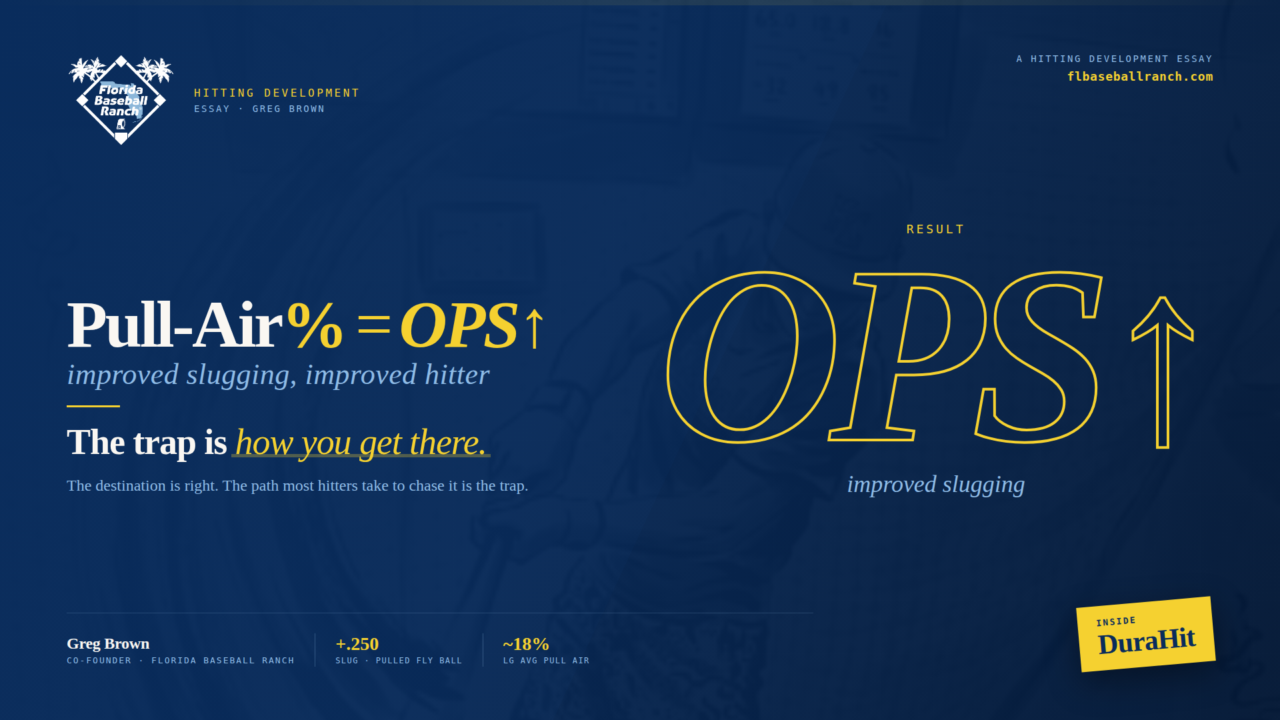
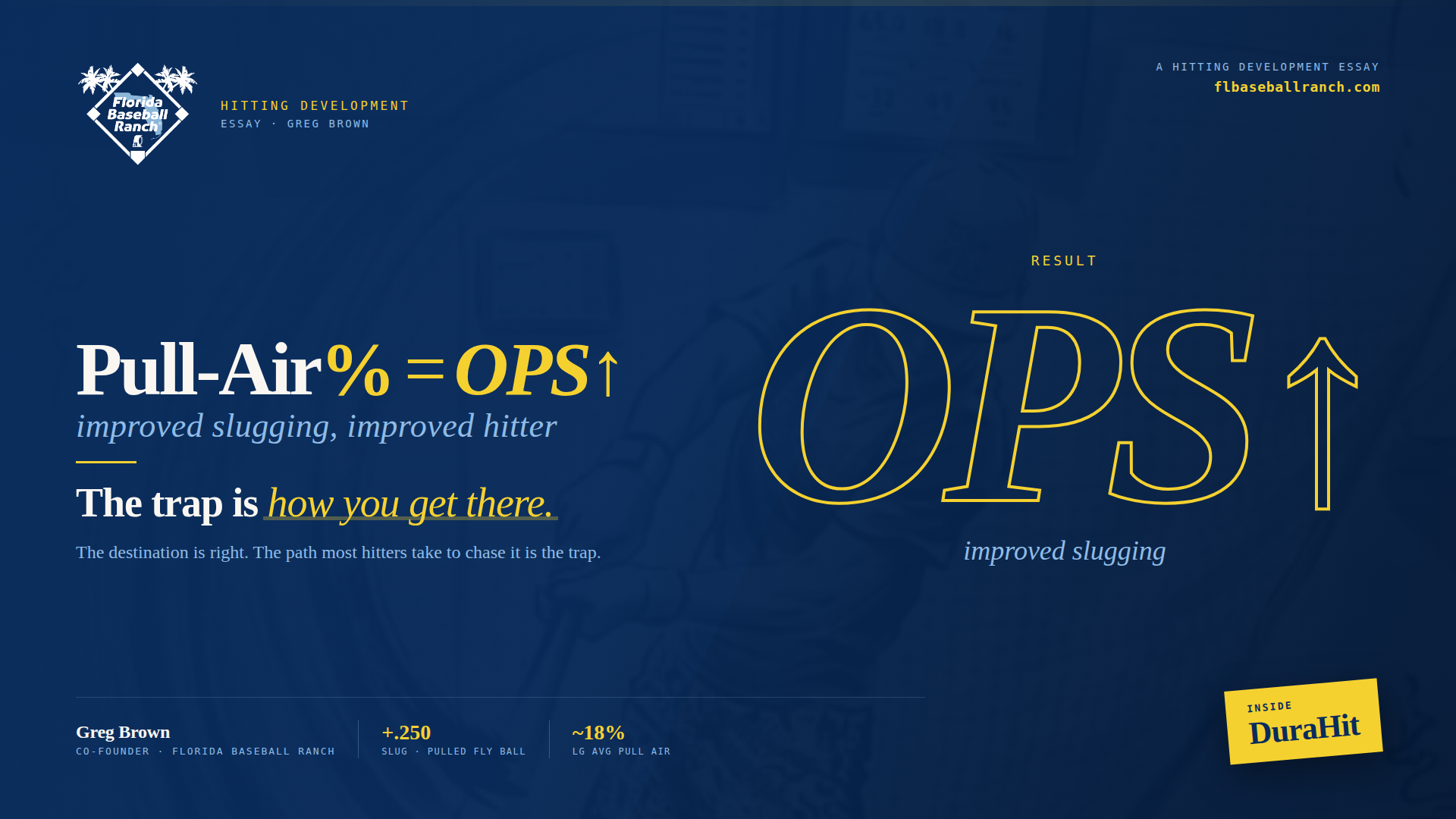
Let's start with what's true. Pull Air percentage — how often a hitter puts a fly ball into the air to their pull side — is one of the strongest predictors of OPS in baseball. The league average sits just above 18 percent. And a pulled fly ball slugs roughly 250 points higher than the same fly ball hit to center or the opposite field.
That's not a small gap. That's the gap between a forgettable season and an All-Star year. The math is real. Pull-Air% drives OPS.
So if you're a hitter who reads about the metric, the conclusion seems obvious. Pull the ball in the air more. Get to 25 percent. Get to 30. Slug your way to the next level.
That's where hitters get lost. The destination is right. The path most of them take to get there is the trap. And there's no better proof than the slumps happening at the major league level right now.
Same Symptom. Different Problems.
A recent breakdown of big league hitters identified ten players with elite barrel rates — meaning they're crushing the ball as hard as anyone in baseball — but disappointing slugging numbers. Nine of them shared the same statistical issue: low Pull Air percentage. They weren't getting the ball into the air to the pull side often enough.
Same symptom across all of them. But when you dig into the actual swings, the root causes are completely different from one hitter to the next.
Some hitters are a tick late. They're seeing more breaking balls and fewer fastballs than they used to, and their timing hasn't quite caught up. The swing shape is fine. The intent is fine. They're just letting the ball travel a fraction of an inch further than they did a year ago, and that fraction is the difference between a barrel pulled in the air and a barrel hit flush to center.
Some hitters have a stance that's drifted. This is the most common one we see. The back foot starts pointing toward the catcher. The front foot lands more open and closer to the plate. To the eye, the hitter looks like they're trying to pull everything. The numbers say the opposite — their pull-side fly balls have nearly vanished. They're fighting against their own body without realizing it.
Some hitters have a swing plane that's too flat. They make hard contact, but the launch angle never gets where it needs to. Pitchers figure it out and start working down in the zone, and the hitter who used to do damage on pitches up in the zone suddenly has nowhere to go. This is rarely an in-season fix. It's a build.
And some hitters are doing almost everything right — getting the ball out front, posting elite bat speed, hitting it on the screws — but their contact is going to center field instead of the pull side. The adjustment they need is the smallest of anyone in the group. A few degrees. A few inches. The kind of tweak you make over the offseason, not the kind you panic about in May.
Same statistical problem. Four different root causes. And a hundred different ways to make each one worse if you don't know what you're actually fixing.
The Lesson Every High School and College Hitter Needs
If you take one thing from all of this, take this:
Pulling the ball in the air is the destination. It's not the path. And the hitters who try to make it the path are the ones who never get there.
When a young hitter walks up to the plate trying to pull the ball, three things tend to happen. The hitter rolls over on the front leg early. The barrel drags behind the hands. Contact moves out in front to a spot the hitter can't actually cover with authority. The result is a weak ground ball to the pull side or a lazy fly ball that doesn't carry.
Trying to pull doesn't make you a pull hitter. It makes you a worse hitter.
A major league hitting coach put it well in a recent interview: pulling the ball or driving the ball is actually less effort. It's trusting the fluidity of the swing, knowing when to take your shot, and being able to catch the ball deeper. That sounds counterintuitive because all the metrics say hitting the ball out front in the air is the best outcome. The metrics aren't wrong. They're just incomplete.
I love something a veteran big leaguer said about this: he practices hitting the ball to the opposite field on purpose. Why? Because if he practices going oppo, he'll pull it in games. If he practices pulling, he'll roll over. The intent in practice has to be the opposite of the desired outcome in games. That's not a paradox. That's how the swing actually works.
What We Build at the Florida Baseball Ranch
When a hitter walks into the Ranch with low Pull Air numbers, we don't hand them a drill to pull the ball more. That would be treating a symptom and ignoring the disease. We diagnose the swing the same way you'd diagnose any of the big leaguers I described earlier — one hitter, one problem at a time.
The four pillars we work from are:
01Stance Alignment
Where are your feet relative to the plate? Where is your weight distributed? Are you in a position to actually use the ground? A drifted stance is the most common quiet killer of pull-side power. The hitter doesn't feel it. The numbers see it immediately.
02Timing and Recognition
Can you adjust between a 95 mph fastball and an 84 mph sweeper without losing your shape? Big league pitchers are throwing more breaking balls than ever, and that trend trickles down to college and high school every year. Recognition training is non-negotiable for elite hitters.
03Contact Point
Where you hit the ball relative to your body is the single biggest determinant of where the ball goes. Out front, you pull. Deep, you go the other way. Most young hitters who can't pull the ball in the air aren't getting deep enough on it in practice. Sounds backwards. It isn't.
04Intent
Are you trying to drive through the ball, or are you trying to steer it to a location? The swings that produce pull-side fly balls in games are the swings where the hitter trusted the move and turned the barrel loose. Steering kills both bat speed and angle.
Stance. Timing. Contact. Intent. Build those four, and Pull Air percentage takes care of itself.
Time Is the Asset You Have That They Don't
Here's the part that should encourage every high school and college hitter reading this.
The big leaguers struggling right now are trying to recover half an inch of bat-ball intercept depth against the best pitching on the planet, in the middle of a season. They're trying to rebuild stances while playing 162 games. They're trying to undo career-long swing shapes against pitchers who already know their weaknesses. These are not easy fixes.
You have something they don't. You have time. You have offseasons. You have practice reps where the only thing on the line is your development. You have the ability to build the swing from the ground up before the bad habits set in.
Don't waste that time chasing a statistic. Build a swing that produces the statistic.
That's the difference between a hitter who plays this game for one season and a hitter who plays it for ten.
Ready to Build It Right?
Stop chasing stats. Start building swings.
The Florida Baseball Ranch works with hitters from high school through the professional ranks on the same diagnostic, development-first approach we use with the most advanced players in the game.
Join DuraHit →flbaseballranch.com/durahit
About the author: Greg Brown is a co-founder of the Florida Baseball Ranch, a former Major League hitting coach, Major League hitting coordinator, Major League scout, and national championship college coach. He has spent more than three decades evaluating and developing hitters at every level of the game.